&geometry(187x114) "ESANZ")
One Year On: Are the 2025 Diastolic Function Guidelines Meeting Expectations? What Seven Independent Validation Studies Tell Us
One year after the release of the 2025 ASE diastolic function guidelines, how are they performing in real-world practice? Bonita Anderson reviews the findings from seven independent validation studies, highlighting how the updated recommendations are improving diagnostic confidence, reducing indeterminate results, and strengthening HFpEF assessment across a range of clinical settings.
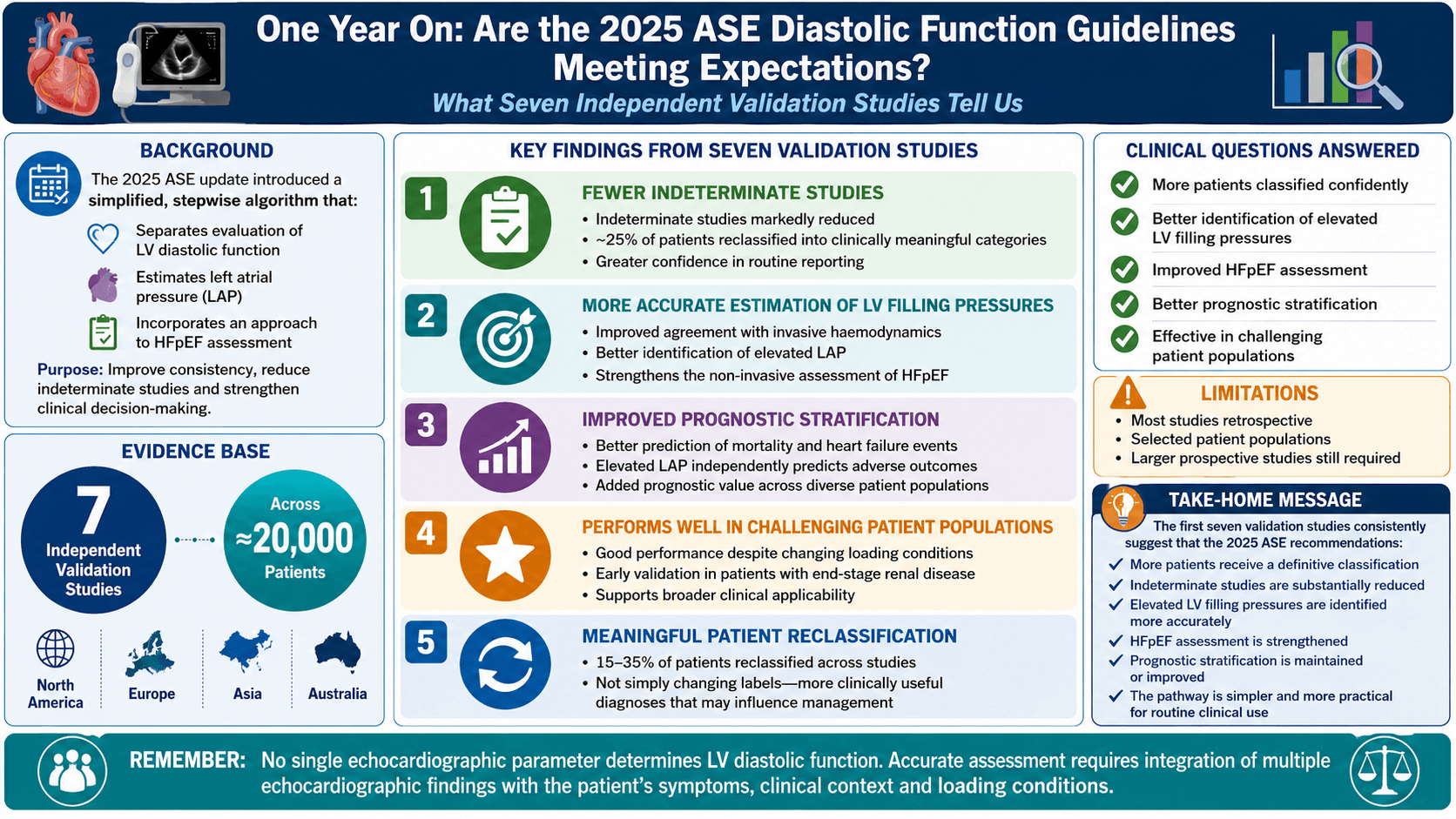
One Year On: Are the 2025 Diastolic Function Guidelines Meeting Expectations?
What Seven Independent Validation Studies Tell Us
Assessment of left ventricular (LV) diastolic function remains one of the most challenging assessments in echocardiography. Importantly, no single echocardiographic measurement can reliably determine diastolic function or estimate LV filling pressures across all clinical settings. Instead, assessment requires an integrated approach that considers multiple echocardiographic findings alongside the patient's symptoms, underlying cardiac disease, and loading conditions.
In July 2025, the American Society of Echocardiography (ASE) published updated recommendations for evaluating LV diastolic function and diagnosing heart failure with preserved ejection fraction (HFpEF). These revised recommendations introduce a simplified, stepwise algorithm that separates assessment of LV diastolic function from estimation of left atrial pressure (LAP) and incorporates a structured approach to HFpEF diagnosis (Nagueh et al., 2025).
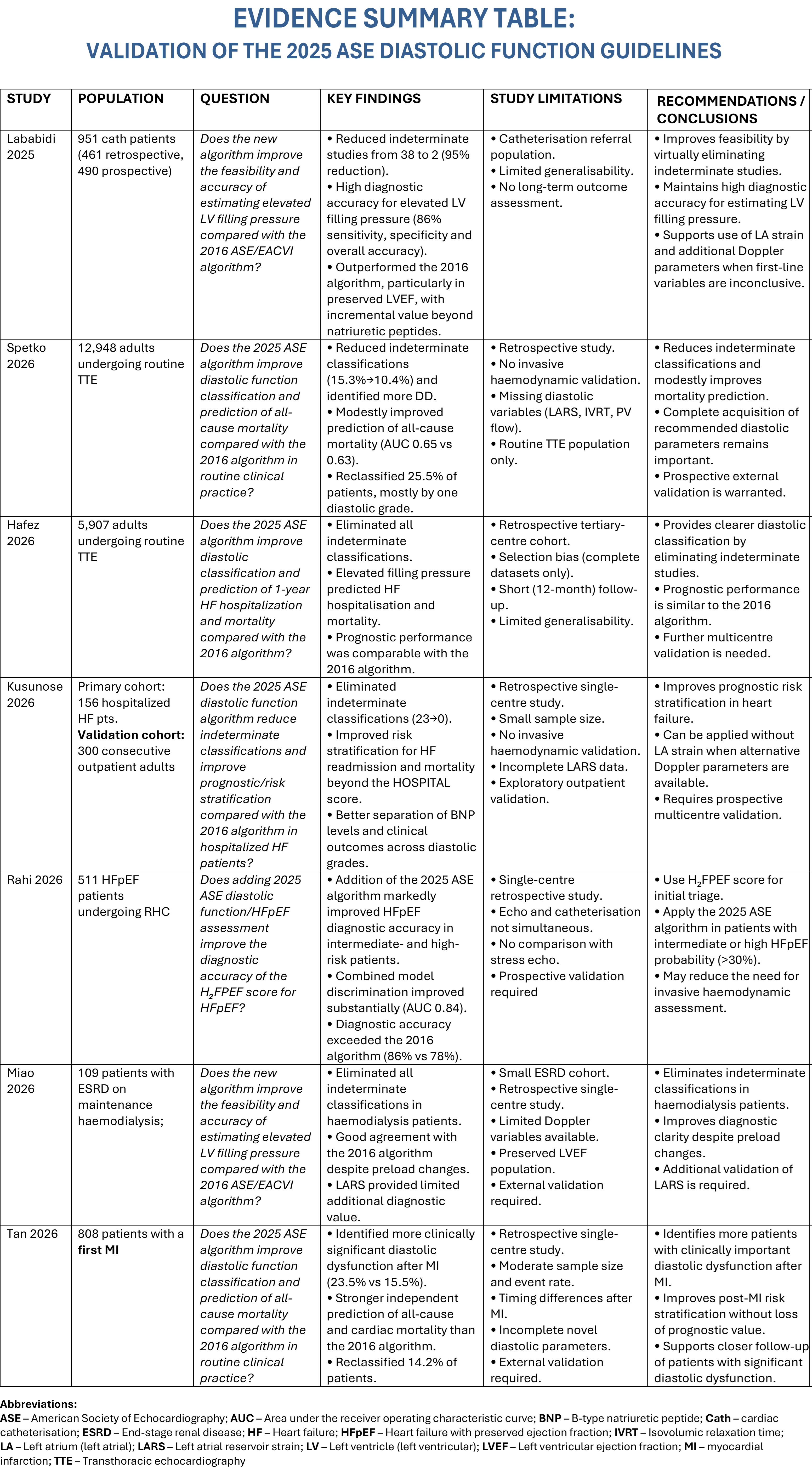
One year later, seven independent validation studies from North America, Europe, Asia, and Australia have evaluated the performance of the updated recommendations across diverse patient populations and clinical settings. Despite these differences, the findings have been highly consistent. Overall, the studies indicate that the 2025 recommendations simplify interpretation, reduce indeterminate classifications, improve identification of elevated LV filling pressures, enhance HFpEF diagnosis, and provide clinically meaningful prognostic information (see Evidence Summary Table).
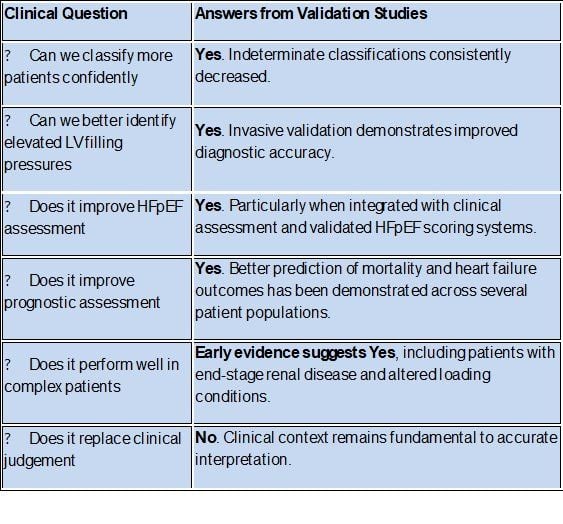
WHAT HAVE THE VALIDATION STUDIES SHOWN?
1. FEWER INDETERMINATE STUDIES
One of the main objectives of the 2025 recommendations was to reduce the number of patients classified as having indeterminate diastolic function.
Across validation studies involving almost 20,000 patients, the updated algorithm consistently reduced—or in some studies eliminated—the indeterminate category while maintaining or improving diagnostic and prognostic performance when compared with the 2016 ASE/EACVI recommendations. Approximately one-quarter of patients were reclassified into clinically meaningful categories, providing greater confidence in interpretation and reporting (Lababidi et al., 2025; Spetko et al., 2026; Hafez et al., 2026).
Bottom line: The 2025 updated algorithm delivers greater diagnostic certainty by substantially reducing indeterminate classifications while preserving or improving diagnostic and prognostic performance.
2. MORE ACCURATE ESTIMATION OF LV FILLING PRESSURES
Accurate estimation of LV filling pressure remains central to the evaluation of patients with unexplained dyspnoea and suspected HFpEF.
Validation against invasive haemodynamic measurements demonstrated that the updated algorithm identifies elevated LV filling pressures more accurately than the previous recommendations, particularly in patients with preserved LV ejection fraction, where diastolic assessment is often most challenging (Lababidi et al., 2025).
Additional evidence suggests that combining the updated ASE algorithm with established clinical scoring systems, such as the H?FPEF score, significantly improves the non-invasive diagnosis of HFpEF compared with clinical assessment alone (Rahi et al., 2026).
Bottom line: The updated algorithm demonstrates better agreement with invasive haemodynamics and improves the non-invasive diagnosis of HFpEF, particularly when integrated with established clinical scoring systems.
3. IMPROVED PROGNOSTIC STRATIFICATION
An important strength of the 2025 recommendations is that they appear to improve identification of patients at increased cardiovascular risk.
Across studies involving patients hospitalised with heart failure and those recovering from myocardial infarction, the updated algorithm more effectively identified individuals at increased risk of mortality and heart failure events than previous recommendations. In addition, classification of elevated LAP also emerged as an independent predictor of adverse outcomes (Kusunose et al., 2026; Spetko et al., 2026; Tan et al., 2026).
Bottom line: The updated recommendations not only improve classification of diastolic function but also provide clinically meaningful prognostic information.
4. PERFORMS WELL IN CHALLENGING PATIENT POPULATIONS
Assessment of LV diastolic function is particularly difficult in patients with altered loading conditions.
Early validation in patients with end-stage renal disease undergoing haemodialysis demonstrated that the updated algorithm improved diagnostic clarity, eliminated indeterminate classifications, and maintained good agreement despite marked fluctuations in volume status (Miao et al., 2026).
Although additional validation is needed in other complex patient populations, these findings suggest the algorithm performs well even under changing haemodynamic conditions.
Bottom line: Early evidence suggests that the updated recommendations remain reliable in challenging clinical settings.
5. MEANINGFUL PATIENT RECLASSIFICATION
Across studies reporting reclassification, approximately 15-35% of patients were assigned a different classification using the 2025 recommendations (Spetko et al., 2026; Miao et al., 2026; Tan et al., 2026).
Importantly, these changes were not merely statistical reclassifications. Many patients previously classified as indeterminate or normal were reassigned to clinically meaningful categories of normal filling pressures, elevated LAP, or graded diastolic dysfunction, potentially influencing subsequent investigation and management.
Bottom line: The revised recommendations appear to improve clinical interpretability by providing more definitive classifications rather than simply changing diagnostic terminology
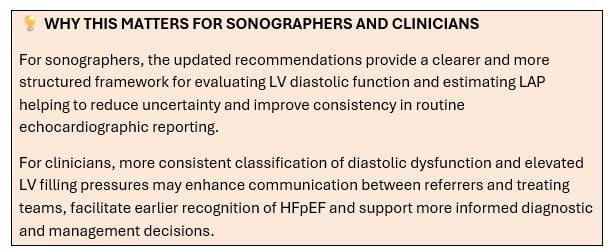
TAKE-HOME MESSAGES
One year after publication, the first wave of validation studies suggests that the 2025 ASE recommendations are achieving many of their intended goals.
- More patients receive a definitive classification.
- Indeterminate studies are substantially reduced.
- Elevated LV filling pressures are identified more accurately.
- HFpEF assessment is strengthened.
- Prognostic stratification is maintained or improved.
- The diagnostic pathway is simpler and more practical for routine clinical use.
Importantly, these studies reinforce one of the central principles underpinning the 2025 ASE recommendations: LV diastolic function cannot be determined from any single echocardiographic variable(Nagueh et al., 2025). Accurate assessment still depends on integrating multiple echocardiographic findings with the patient's symptoms, clinical history and overall probability of disease. The updated algorithm provides a clearer, evidence-based framework to support that process and help us make more confident, consistent interpretations.
REFERENCES (Alphabetical):
Hafez A, Farina JM, Ahmed S, Awad K, Pietri MP, Scalia IG, Abdelfattah F, Razaghi M, Chollet L, Nour M, Ibrahim R, Shipman J, Lester SJ, Ayoub C, Oh JK, Arsanjani R. Reclassifying Left Ventricular Diastolic Function with the 2025 American Society of Echocardiography Guideline versus the 2016 Algorithm. J Am Soc Echocardiogr. 2026 Jun;39(6):567-577. doi: 10.1016/j.echo.2026.02.013.
Kusunose K, Ooka S, Yamada H, Sata M. The 2025 Echocardiographic Diastolic Function Algorithm is Associated with Improved Risk Stratification in Hospitalized Patients with Heart Failure. J Am Soc Echocardiogr. 2026 Apr;39(4):373-384. doi: 10.1016/j.echo.2025.12.008.
Lababidi H, Rahi W, Smiseth OA, Billick K, Inoue K, Khan FH, Andersen ØS, García-Izquierdo E, Ha JW, Ohte N, Gude E, Mohan RC, Heywood JT, Klein A, Nagueh SF. New Algorithm for Estimating Left Ventricular Filling Pressure by Echocardiography. Circulation. 2025 Aug 19;152(7):424-435. doi: 10.1161/CIRCULATIONAHA.125.074974.
Miao Y, Chen W, Liao Y, Yao Y, Zhang Y. Impact of 2025 ASE Update Recommendations for the Evaluation of Left Ventricular Diastolic Function in Patients With End-Stage Renal Disease. Echocardiography. 2026 Apr;43(4):e70456. doi: 10.1111/echo.70456. PMID: 41954282.
Nagueh SF, Sanborn DY, Oh JK, Anderson B, Billick K, Derumeaux G, Klein A, Koulogiannis K, Mitchell C, Shah A, Sharma K, Smiseth OA, Tsang TSM. Recommendations for the Evaluation of Left Ventricular Diastolic Function by Echocardiography and for Heart Failure With Preserved Ejection Fraction Diagnosis: An Update From the American Society of Echocardiography. J Am Soc Echocardiogr. 2025 Jul;38(7):537-569. doi: 10.1016/j.echo.2025.03.011. PMID: 40617625.
Rahi W, Lababidi H, Hussain I, Quinones MA, Nagueh SF. Improving the Diagnosis of HFpEF: A Comparison of the H2FPEF Score and the 2025 ASE Diastolic Function Guideline Recommendations Using Invasive Hemodynamics as the Gold Standard. JACC Cardiovasc Imaging. 2026 Feb;19(2):166-174. doi: 10.1016/j.jcmg.2025.09.011.
Spetko N, Scott CH, Angell-James C, Cassidy M, Alwani T, Mukherjee M, Nagueh SF, Strom JB. Reclassification of Diastolic Function by the 2025 American Society of Echocardiography Diastolic Function Guidelines and Risk of Mortality. J Am Soc Echocardiogr. 2026 May;39(5):501-510. doi: 10.1016/j.echo.2026.01.006.
Tan C, Eaves S, Lo A, Mallouhi M, Vollbon W, Wahi S, Thomas L, Atherton JJ, Prasad SB. Diastolic dysfunction assessed by the 2025 American Society of Echocardiography guidelines and survival following myocardial infarction. Int J Cardiol. 2026 May 15;451:134246. doi: 10.1016/j.ijcard.2026.134246.
)