&geometry(187x114) "ESANZ")
Distinguishing between pre- and post-capillary pulmonary hypertension is essential for guiding appropriate treatment. In this blog, Bonita Anderson discusses how echocardiography may aid in making thi
Bonita Anderson presents this second of her two-part series of Echo in pulmonary hypertension.
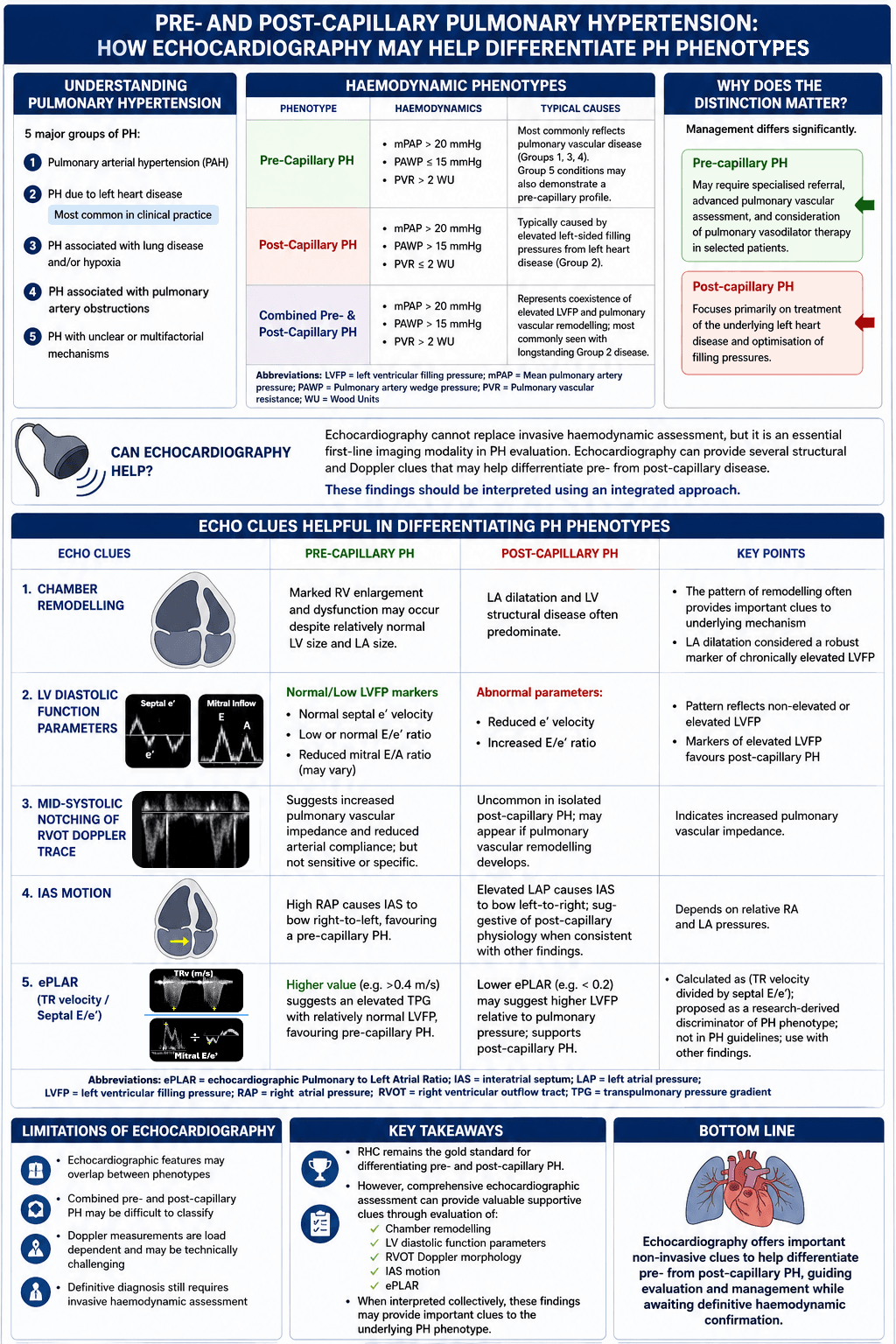
Pre- and Post-Capillary Pulmonary Hypertension: How Echocardiography May Help Differentiate PH Phenotypes
This follows on from the ESANZ blog on “Beyond RVSP: The New Era of Echo Assessment in Pulmonary Hypertension”.
UNDERSTANDING PULMONARY HYPERTENSION
Current guidelines classify PH into five major groups according to the underlying mechanism responsible for the elevated pulmonary pressures:
- Pulmonary arterial hypertension (PAH)
- PH due to left heart disease
- PH associated with lung disease and/or hypoxia
- PH associated with pulmonary artery obstructions
- PH with unclear or multifactorial mechanisms
Among these, Group 2 PH — due to left heart disease — is by far the most common form, accounting for a large proportion of cases in clinical practice.
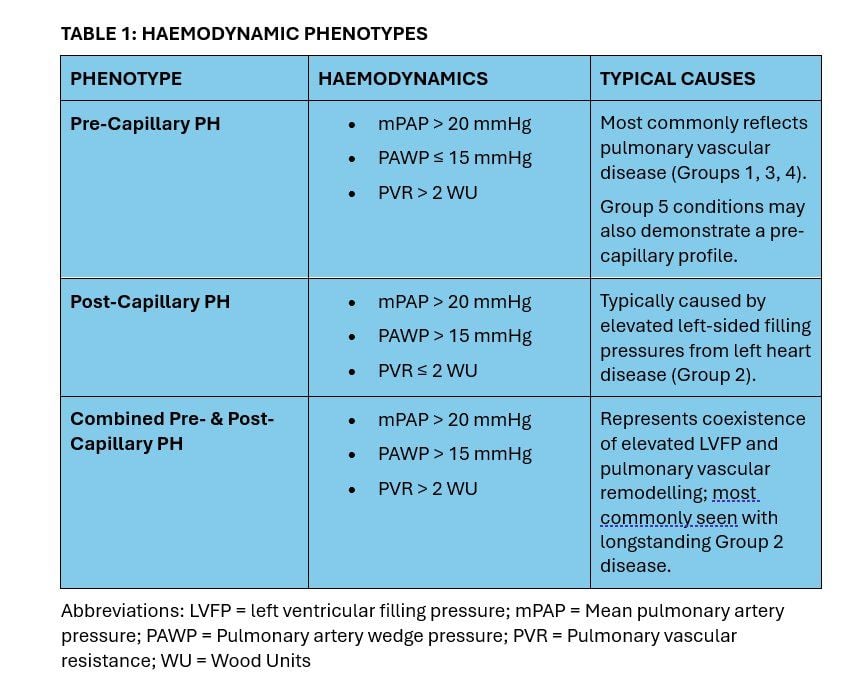
In addition to aetiological classification, PH is can also be categorised into the following haemodynamic phenotypes:
- Pre-capillary PH
- Post-capillary PH
- Combined pre- and post-capillary PH
Haemodynamic differentiation of these phenotypes, along with typical causes, is summarised in Table 1. Classification is determined invasively using right heart catheterisation (RHC), which remains the diagnostic gold standard.
WHY DOES THE DISTINCTION MATTER?
Differentiating PH phenotype is critical because management differs significantly:
- Pre-capillary PH may require specialised referral, advanced pulmonary vascular assessment, and consideration of pulmonary vasodilator therapy in selected patients.
- Post-capillary PH management focuses primarily on treatment of the underlying left heart disease and optimisation of filling pressures.
CAN ECHOCARDIOGRAPHY HELP?
Although echocardiography cannot replace invasive haemodynamic assessment, it remains the essential first-line imaging modality in PH evaluation and can provide several structural and Doppler clues that may help differentiate pre- from post-capillary disease. These findings are best interpreted using an integrated approach that incorporates:
- Cardiac chamber structure
- LV diastolic function parameters
- Right heart remodelling
- Doppler haemodynamics
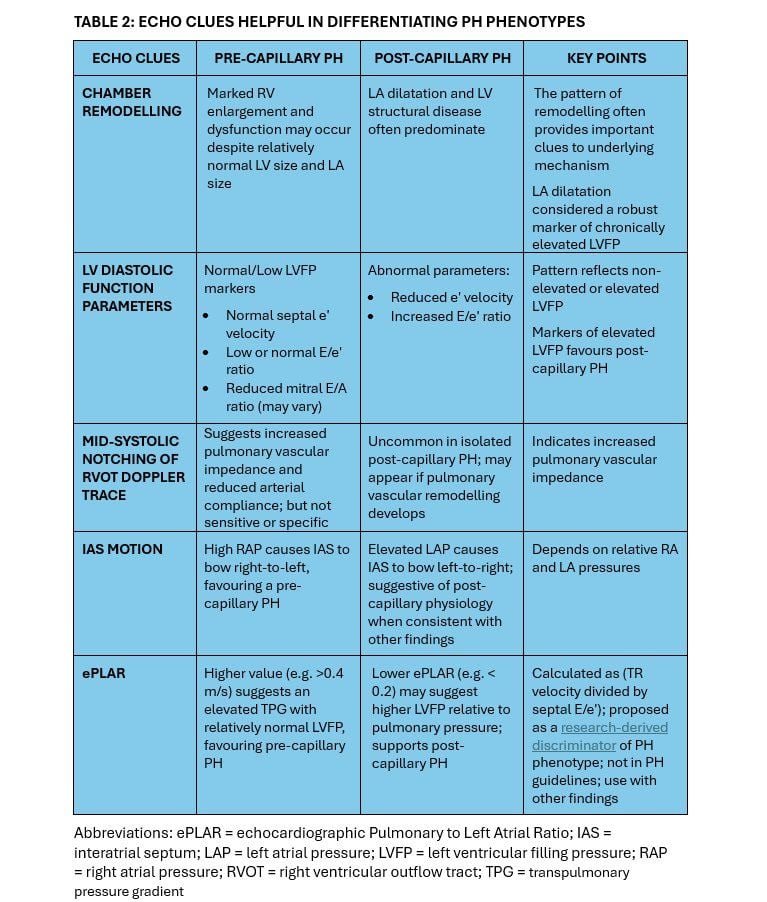
Key echocardiographic features that may help differentiate pre- from post-capillary PH are summarised in Table 2.
WHAT ABOUT ECHOCARDIOGRAPHIC ESTIMATION OF PVR?
Although echocardiography can estimate PVR, current guidelines do not recommend its routine clinical use because it is derived from indirect Doppler-based measurements and is subject to significant variability and reduced accuracy, particularly in advanced pulmonary vascular disease. It also does not replace invasive haemodynamic assessment.
LIMITATIONS OF ECHOCARDIOGRAPHY
Despite its value, echocardiography has important limitations in PH phenotyping:
- Echocardiographic features may overlap between phenotypes
- Combined pre- and post-capillary PH may be difficult to classify
- Doppler measurements are load dependent and may be technically challenging
- Definitive diagnosis still requires invasive haemodynamic assessment
KEY TAKEAWAYS
RHC remains the gold standard for differentiating pre- and post-capillary PH. However, comprehensive echocardiographic assessment can provide valuable supportive clues through evaluation of:
· LA size
- LV diastolic function parameters
- RVOT Doppler morphology
- IAS motion
- ePLAR
When interpreted collectively, these findings may provide important clues to the underlying PH phenotype.
References and Further Readings
Humbert M, Kovacs G, Hoeper MM, et al; ESC/ERS Scientific Document Group. 2022 ESC/ERS Guidelines for the diagnosis and treatment of pulmonary hypertension. Eur Respir J. 2023 Jan 6;61(1):2200879.
Mukherjee M, Rudski LG, Addetia K, et al. Guidelines for the Echocardiographic Assessment of the Right Heart in Adults and Special Considerations in Pulmonary Hypertension: Recommendations from the American Society of Echocardiography. J Am Soc Echocardiogr. 2025 Mar;38(3):141-186.
Scalia GM, Scalia IG, Kierle R, et al ePLAR - The echocardiographic Pulmonary to Left Atrial Ratio - A novel non-invasive parameter to differentiate pre-capillary and post-capillary pulmonary hypertension. Int J Cardiol. 2016 Jun 1;212:379-86.
)